Physics stacking
Stackfall
One tap per block. A rocket built one part at a time.
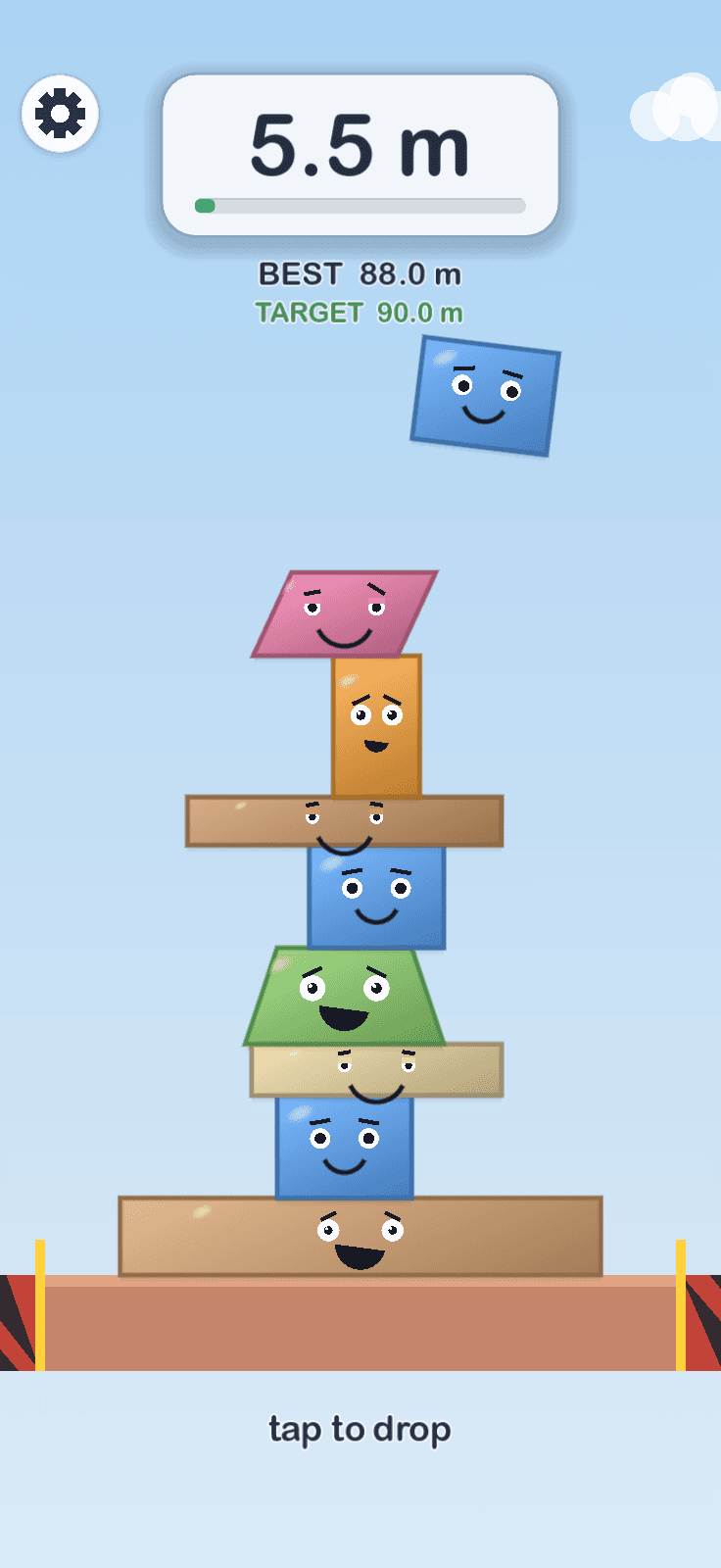
Stackfall 2.0 gives every run a goal. A crane sweeps each block across the tower on a fixed arc you cannot nudge, aim or undo, so you choose only the moment you let go. A little climber rides your tower, and above him a rocket part hangs from a balloon: stack high enough and he grabs it, the run ends as a win, and the next part hangs a little higher.
How Stackfall plays
One input, no take-backs
The arc is fixed and the crane never stops, and a dropped block keeps the crane's sideways speed. That single choice of timing is all that stands between the tower and gravity. A drop that misses costs you the block; a tower that topples costs you the run.
A rocket, then a station
Eight parts build a rocket, from a bolt at 2.5 metres to an antenna at 16, and finishing it launches it past everything living in the sky. A second chapter builds a space station from 12 to 26 metres, with block budgets and parts hung off to the side.
Unlocks that help you climb
Parts bring new capability with them rather than costumes: a wide deck to steady a wobble, leaning and offset blocks, a preview of the block that comes next. The physics never changes, and the game never speeds up.
Every block is somebody
Each piece is a small character with a face and a temperament. They squint and sweat as the tower sways, and whichever one finally falls gets spiral eyes for its trouble. Higher up, the sky starts watching back.
At a glance
- Genre
- Physics stacking
- Platforms
- iOS and Android
- Input
- One tap
- Price
- Free to play
Official site
More from DevCraftAI
- ReboundPrecision timing
- TapCultReflex timing
- Polarity GridLogic puzzle